
Nyhed
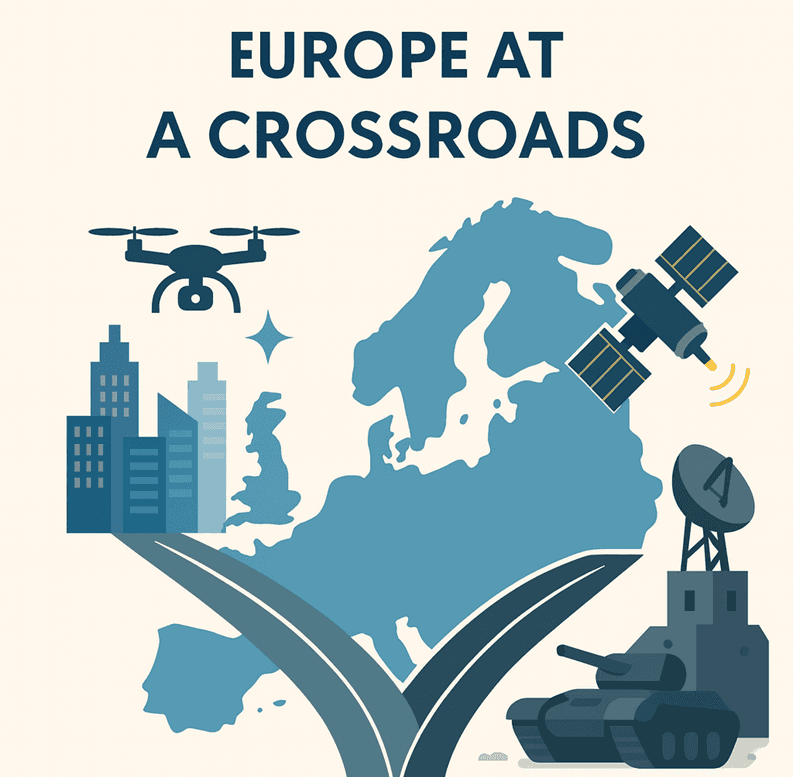
Sprinting towards sovereignty or locked into legacy: European defence at a crossroads
Lagt online: 03.10.2025
Nyhed
Sprinting towards sovereignty or locked into legacy: European defence at a crossroads
Lagt online: 03.10.2025
Europe at a crossroads
Nyhed
Lagt online: 03.10.2025
Nyhed
Lagt online: 03.10.2025
By Colleen Laughlin and Jeffrey Saunders
Europe is striving to assert itself as a sovereign security actor in an increasingly volatile and contested world. Russia’s invasion of Ukraine shattered assumptions of lasting peace and exposed Europe’s dependency on foreign technologies, fragmented procurement systems, and slow-moving innovation pipelines.
At the same time, the global race for technological dominance in emerging technologies like AI, quantum computing, autonomous systems, and space is accelerating, with China and the United States pulling ahead.
Europe must reconcile two imperatives: urgently closing critical capability gaps by 2030 while investing in the disruptive technologies that will shape future warfare.
With a cumulative €1.1 trillion defence funding
shortfall, weak economic growth, and different abilities to afford higher military spending, the challenge facing Europe is stark. The dilemmas posed by these imperatives raise questions about what European strategic autonomy entails and whether it is feasible.
The European Union, however, is uniquely positioned to foster a more autonomous Europe—leveraging legal authority, financial tools, and industrial policy—but only if member states align on priorities and overcome entrenched national interests.
We have outlined four plausible scenarios for European defence and dual-use technology innovation through 2035, structured around two core axes of uncertainty:
● Europe’s ability to achieve tech sovereignty – Will Europe’s legal and budgetary power lead to a renaissance of European defence innovation, or will Europe continue to rely predominantly on foreign (mainly US) procured offerings.
● Innovation tempo and openness – Will capability development follow an open, agile mode, where emerging technologies feature strongly in new military capabilities, or remain closed and legacy-bound, dominated by traditional procurement cycles, incumbents, and legacy equipment?
The four scenarios explore how these forces interact with political shocks and operational realities. Each scenario considers implications for the transatlantic alliance, the Nordic region’s strategic role, and the interplay between defence and civilian innovation:
Fortress Europe:
Europe imposes “buy-European” rules and prioritises national champions. While capability gaps narrow, protectionism and fragmentation undermine interoperability and long-term innovation. Europe arms itself but lacks collective power projection.
Sovereign Sprint:
A strong EU-led push creates a vibrant defence-tech ecosystem with startups, dual-use technologies, and integrated Ukrainian innovations. NATO standards ensure interoperability, but industrial
and data frictions with the U.S. intensify. Europe achieves real sovereignty but at the cost of transatlantic tensions.
Alliance-Driven Acceleration:
NATO and the EU synchronise innovation. The Rapid Adoption Action Plan (RAAP) and EU instruments form a joint engine that delivers interoperable systems at speed and scale.
Europe gains strength through deepened transatlantic cooperation but remains dependent on U.S. technology leadership.
Locked-In Legacy:
Europe fails to reform. Procurement fragmentation, risk aversion, and reliance on foreign primes persist. Innovation stagnates, startups exit the market, and Europe continues to be a consumer of off-the-shelf foreign systems. Ambitions of sovereignty and agility fade into irrelevance.

Alle danske universiteter og fem Godkendte Teknologiske Serviceinstitutter er gået sammen i NFC - Nationalt Forsvarsteknologisk Center for at samarbejde med Forsvaret og industrien om forsvarsteknologisk udvikling. Målet er at bidrage til Danmarks forsvar og sikkerhed.